
How to Evaluate AI Model Performance
A beginner-friendly walkthrough of the metrics, trade-offs, and product decisions behind every good AI system.

Welcome back to the AI Product Journal.
In the last edition, we explored the AI PRD Blueprint, what makes an AI PRD fundamentally different from the traditional version, and how PMs can document features that learn, adapt, drift, and evolve. If you missed it, you can read it here
Now that you understand how to write for AI systems, it’s time to understand how to evaluate them.
The thing is, you can document the best AI idea in the world, but if you can’t evaluate a model, you can’t ship it responsibly.
And evaluation is not just a technical activity, It’s a product activity also.
PMs might not train the model, but they decide:
What “good” looks like
What “bad” looks like
What trade-offs matter most
When a model is safe to launch
When an experiment is successful
And when to stop, restart, or rethink the entire approach
So in today’s edition, we’ll cover:
How to evaluate a model without being a data scientist
The difference between model metrics and product metrics
Accuracy vs Precision vs Recall (in everyday product language)
How to design simple, effective AI experiments as a PM
What to review before a model goes live
Let’s get started.
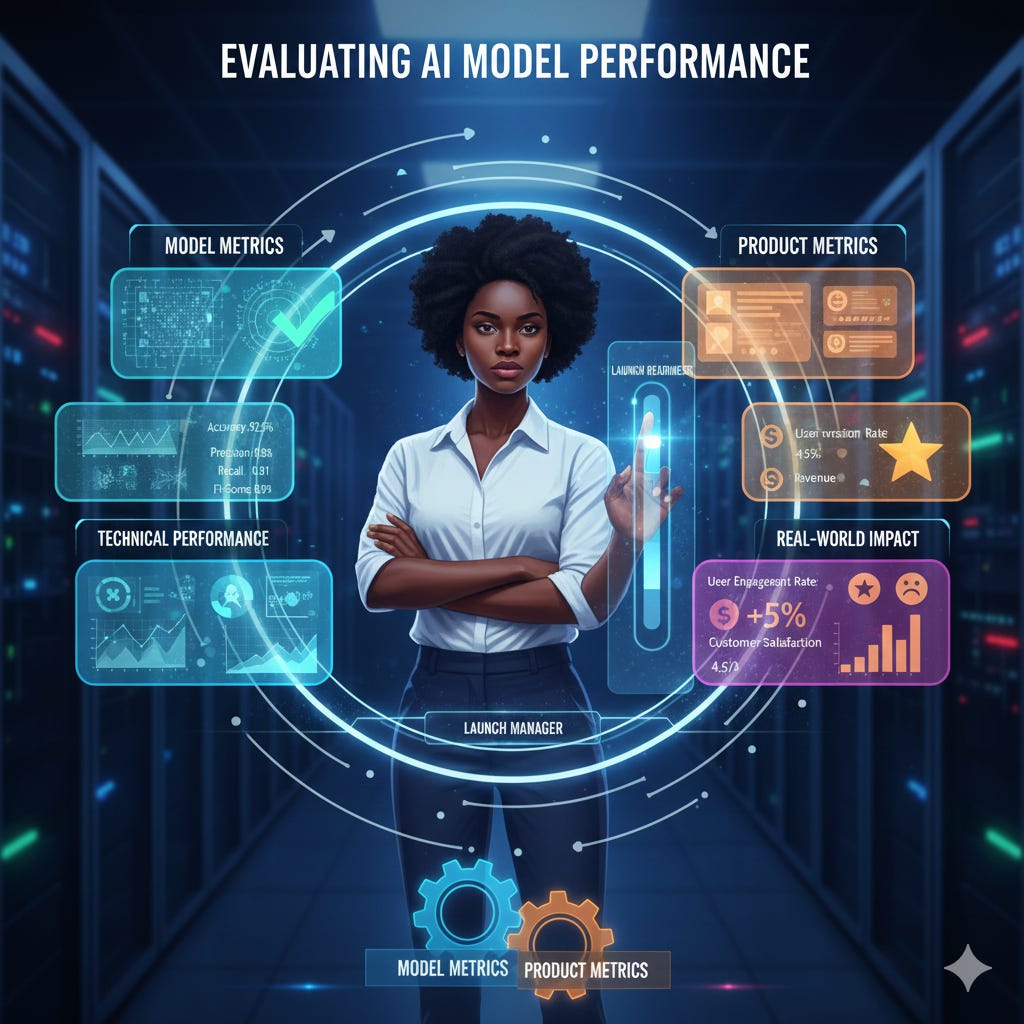
1. How to Evaluate a Model Without Being a Data Scientist
You do not need to understand the math behind AI models.
But you must understand how to evaluate whether a model is:
Trustworthy
Useful
Safe
Ready for users
Good enough to ship
You evaluate a model the same way you evaluate any product decision:
Is it solving the right problem?
Is it reducing user effort or friction?
Is it performing consistently?
Does it fail gracefully, or dangerously?
Is it predictable enough to rely on?
Your role is not to critique the model architecture.
Your role is to judge the model’s behaviour in real-world conditions, the exact same way you’d review usability testing or funnel data.
Think of model evaluation as “user testing for the intelligence layer.”
You observe:
where it struggles
where it misfires
where it overconfidently gives wrong answers
where users get confused
where it performs beautifully
This mindset makes you an effective AI PM, without ever touching code.
2. Model Metrics vs Product Metrics
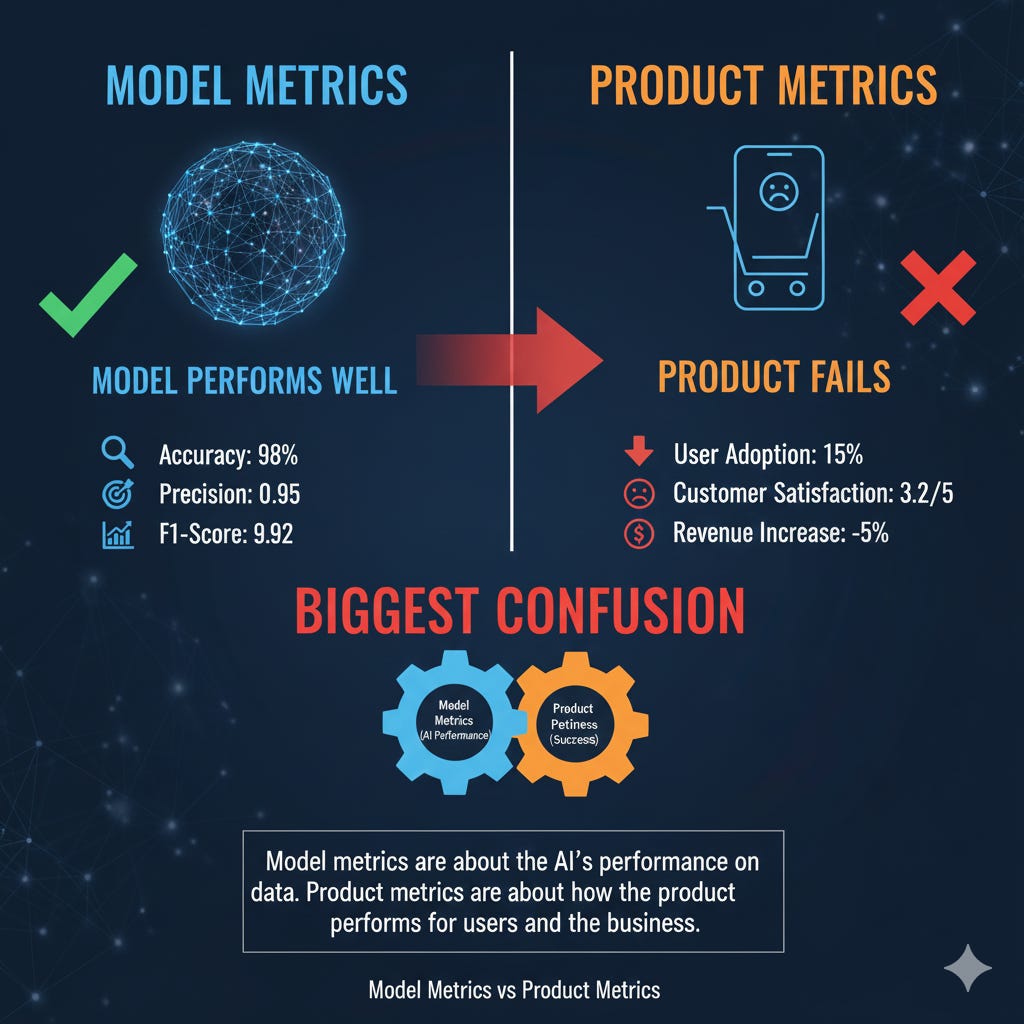
One of the biggest sources of confusion for new AI Product Managers is this:
A model can perform well… and the product can still fail.
That’s because model metrics and product metrics measure two completely different things, even though they work together.
Let’s break them down in plain language your readers will get immediately.
A. Model Metrics -“Is the model doing the math correctly?”
These metrics tell you how well the model is performing its technical task.
Think of them as the “internal accuracy” of the machine.
Examples:
Accuracy – Of all predictions, how many were correct?
Precision – When the model predicted a positive outcome, how often was it right?
Recall – How many of the actual positive cases did the model successfully find?
F1 score – A balanced way of combining precision and recall.
AUC/ROC – How well the model separates different classes.
These metrics answer questions like:
“Is the model identifying patterns correctly?”
“Does it understand the difference between X and Y?”
“Is it making too many costly mistakes?”
But here’s the catch:
A model can have great numbers here and still contribute zero value to your users.
B. Product Metrics - “Is the model creating real-world value?”
These metrics measure the impact of the model inside the product.
They reflect whether users behave differently because the model exists.
Examples:
Reduction in time-to-complete a task
Increase in feature adoption
Increase in revenue per user
Decrease in customer support tickets
Fewer drop-offs during a key workflow
More successful user outcomes
These metrics answer:
“Is this model actually solving the user’s problem?”
“Is the business gaining anything from this?”
“Are users changing their behavior because the model is here?”
A Simple Story to Make the Difference Click
Imagine you’re building an “AI Email Categorizer.”
The model is doing a technical job: determining whether an email is urgent, important, or routine.
Scenario:
Your model achieves 92% accuracy.
That sounds fantastic, right?
But when you measure the product impact, you discover:
Only 14% of users opened the “AI-sorted inbox.”
38% of users turned the feature off.
There was 0% reduction in time spent managing emails.
What does this tell you?
The model worked well.
The product didn’t.
Why?
Because success in AI products is not just about prediction accuracy.
It’s about the flow of value from the model → into the interface → into user behavior → into business impact.
3. Accuracy vs Precision vs Recall (Explained Using a Real Software Product Case Study)
Let’s imagine you’re a PM at a customer-support platform like Zendesk or Intercom, and you’re building an AI system that automatically detects “Urgent Tickets.”
Your job:
Help support teams quickly identify tickets that need immediate attention.
A. Accuracy - “How often did the model get it right overall?”
Let’s say the AI reviewed 1,000 support tickets.
It correctly labeled 850 tickets
It misclassified 150 tickets
That means 85% accuracy.
Sounds great, right?
Not so fast.
Here’s the catch:
If only 50 tickets were actually urgent, the model could simply label everything as ‘not urgent’, and still get 95% accuracy, because it’s technically “right” most of the time.
- Accuracy can look great even when the model completely fails at the actual job (finding urgent issues).
This is why PMs shouldn’t rely on accuracy alone, it hides danger.
B. Precision - “When the AI says a ticket is urgent, how often is it correct?”
Precision tells you how trustworthy the model is when it makes a positive prediction.
Example:
The AI flagged 40 tickets as urgent.
But only 20 of those were actually urgent.
Precision = 20/40 → 50%
Meaning:
Half of the alerts were false alarms.
Why this matters:
If support agents constantly click into “urgent” tickets… only to find normal requests,
they’ll stop trusting the AI and eventually ignore it.
High precision = fewer false alarms → happier support agents.
C. Recall - “Out of all the real urgent tickets, how many did the AI actually catch?”
Let’s say there were 50 real urgent tickets. The AI correctly identified 20 of them.
Recall = 20/50 → 40%
Meaning:
The AI missed 30 urgent issues.
Why this matters:
Those 30 missed urgent tickets could blow up into:
escalations
SLA breaches
angry customers
churn
- High recall = fewer misses → safer operations.
4. How to Design Simple, Effective AI Experiments as a PM
AI experiments are not complex, they follow the same principles as product experiments, with one twist:
You’re testing the model AND the user experience at the same time.
Here’s the simplest structure:
Step 1: Define one job the model must improve
Example:
“Reduce time spent categorizing emails.”
Step 2: Identify the user behavior that signals success
Examples:
Faster task completion
Higher adoption
Fewer manual corrections
Step 3: Run a safe, scoped experiment
Examples:
Release to 5% of traffic
Use synthetic or anonymized data
Limit the model to suggestions instead of automatic actions
Step 4: Measure both sides
Model metrics - Is the model behaving correctly?
Product metrics - Is the user benefiting or struggling?
Step 5: Tune, adjust, and retest
AI rarely gets it right the first time.
Iteration is expected, not a sign of failure.
5. What to Review Before a Model Goes Live
Before you ship ANY AI feature, you must check six things:
1. Data quality
Is the data clean, recent, representative, and unbiased?
2. Model stability
Does the model behave consistently across different scenarios?
3. Failure behavior
Does it fail safely, or dangerously?
4. User understanding
Do users know what the model is doing, and why?
5. UX clarity
Does the interface make the model’s output helpful and usable?
6. Monitoring readiness
Do you have a plan for tracking:
accuracy drift
user feedback
unusual patterns
error spikes
performance issues
AI products are living systems. They don’t stay “good” without continuous monitoring.
Key Takeaways
You can evaluate models confidently without being a data scientist.
Model metrics tell you whether the math works, product metrics tell you whether users benefit.
Accuracy, precision, and recall are simple once you understand the scenarios behind them.
A “good” model can still create a bad product experience.
PMs must design simple, safe experiments to validate model + UX together.
Before launch: test data, stability, UX clarity, safety, and monitoring.
Closing
AI product management is not about mastering algorithms.
It’s about mastering judgment, the ability to understand how intelligence flows from the model into the product, and from the product into user behavior.
Next week, we’ll build on this foundation and explore how to run AI A/B tests, rapid prototyping with APIs and experiment pipelines the right way, even in teams without mature ML infrastructure.
Brilliant. This articulates so clearly why evaluation is not just a technical task but a fundemental product responsability. It's crucial for PMs to understand these metrics to ensure responsible AI deployment, even without deep mathematical understanding.